

Lately, the urge has been strong to refrain from entering social media on the days of significance in national history. I experimented with this on 7th March as much as I could, yet fell into the endless debates over the historic speech of Sheikh Mujibur Rahman, oscillating between a few extremes ranging from “the speech was not important” to “without the speech the war would have been impossible”. Historian Moontasir Mamoon once went so far as to say that Bangbandhu Sheikh Mujibur Rahman liberated a nation who were unwilling to liberate itself, and this sentiment still resonates with a lot of people, it seems. On 26th March, it was expected that the Declaration of Independence debate would occur, and the promise was fulfilled.
Thomas Carlyle famously stated, “The history of the world is but the biography of great men”, a statement summarising the theory known as the Great Man Theory of history. This way of looking at history emphasises the role of seemingly “Great Men”, who alone shape the forces of history by dint of their work, speeches and other contributions. This theory more or less ignores the masses, claiming that ordinary masses do not change the course of history significantly, unless pushed by a great leader or figurehead.
Both sides of the debate in Bangladeshi history seem to rely on this theory. For example, the Declaration of Independence debate. On the one hand, there is a claim that Bangabandhu Sheikh Mujibur Rahman declared independence, which was later broadcast from Kalurghat Radio Station. Another claim is that it was not Sheikh Mujibur Rahman, but rather Major Ziaur Rahman, who declared the independence of Bangladesh, and said, “We Revolt”.
Interestingly, quite a similar debate originated in the aftermath of the July Uprising 2024 as well, which focused on the question of who was the real proponent of “Ek Dofa”(One Demand). The candidates ranged from Professor Anu Muhammad to Nahid Islam and a few more. There were op-eds written in different newspapers unearthing the “true” history of “Ek Dofa”, which supposedly was pronounced on the 2nd or 3rd August 2024.
But what changes? What does it change if the declaration was given by Sheikh Mujibur Rahman rather than Major Ziaur Rahman, or vice versa? The resistance of Bangladeshi citizens was a historical necessity in the face of the genocide that started with “Operation Searchlight” on the night of 25th March. Even if there was previously no incentive to fight the West Pakistani state apparatus prior to 25th March, it was lost that night. The legitimacy of the Pakistani state collapsed. Initially, the resistance came from armed forces, as they had the resources, which soon spread to a wider mass.
Does it mean that the Declaration of Independence was unnecessary? Far from it. The declaration and the subsequent developments, such as the Mujibnagar Government, gave the liberation war of 1971 political legitimacy, and they represented Bangladesh on the international forums. But it was primarily the genocide which prompted the resistance of common folks in Bangladesh. This part gets quietly lost when the focus remains solely on the events, such as the Declaration of Independence. 1971 is a history too big to comprehend or contain in one day, and this attempt discredits the mass population who took part in the war in different forms. The liberation war is, in its truest sense, a People’s War, and this feature should not be forgotten in any discussion.
Yet, there is another dimension to this debate and the one that ensued after the July Uprising – division and legitimacy. Both sides, for the most part, are not interested in this debate only because of historical nuance and accuracy, but also in the manufacturing legitimacy to govern. It is an implication that whichever side has the “correct” history should be allowed to rule the state. This has been the rulebook of the Bangladesh Awami League for a long time. According to them, because Sheikh Mujibur Rahman was the leader of the Awami League during the liberation war, they are the only true heirs of the liberation war and subsequently Bangladesh. This is supposed to be the grant of political legitimacy for eternity. Those who were not with the Awami League were branded as anti-liberation war by definition. The same move for the Bangladesh Nationalist Party is to put Ziaur Rahman on the same level by focusing on the fact that his voice reverberated over Bangladesh through Kalurghat Radio Station.
Interestingly, the same “ownership” debate originated after the July Uprising as well. While political forces from the left, right and centre and most especially, the masses, all participated in the toppling of Sheikh Hasina, there has been a tendency to claim sole ownership of the July Uprising among a few political outlets. And this claim isn’t supposed to be supported by how much they are upholding the spirit of inclusivity and justice of July, but rather on minute details on who spoke what first. Once again, the mass of the “mass” uprising got lost.
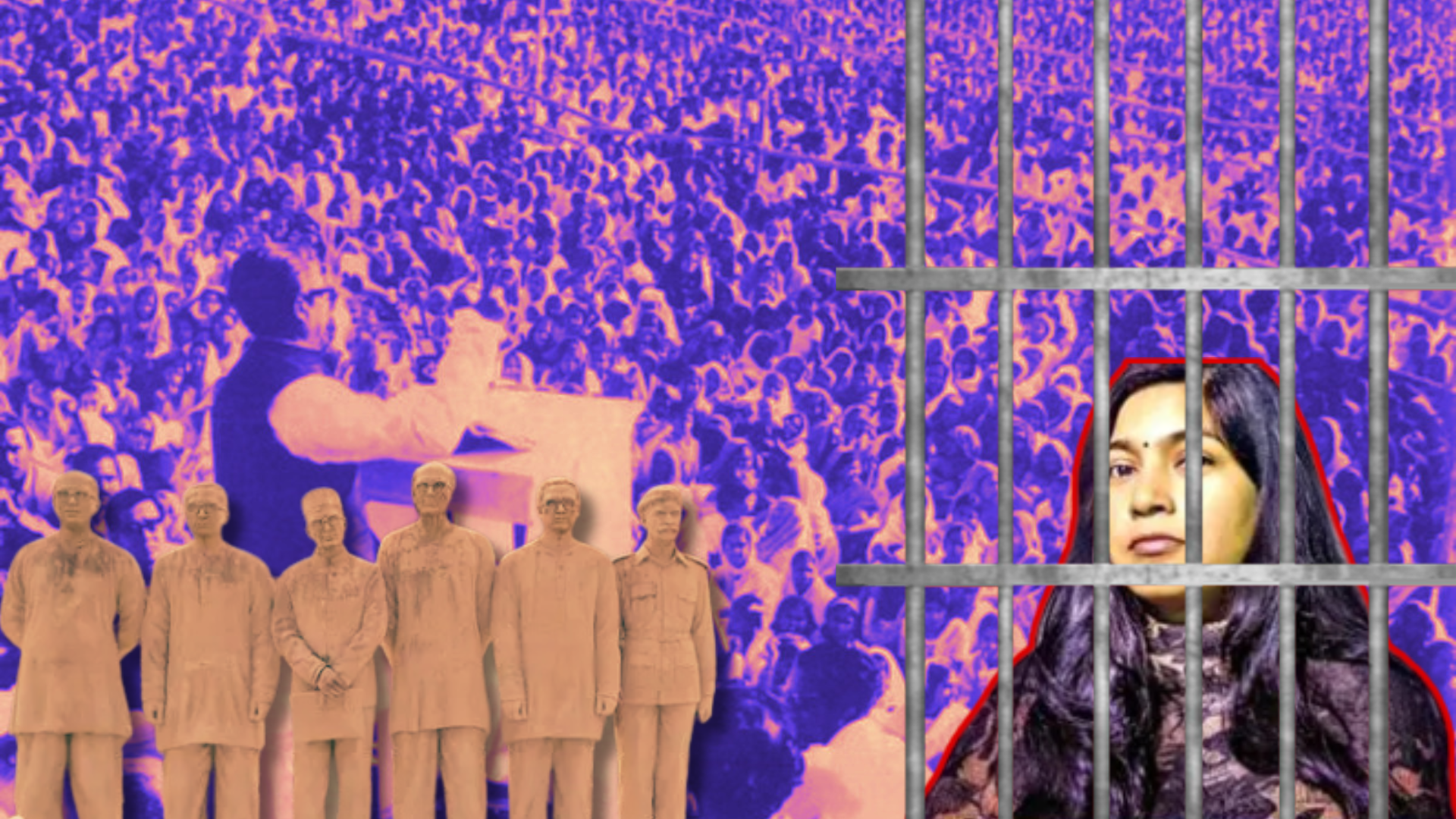
Therefore, the debate over history doesn’t remain a debate over historical inquiry – it turns into a legitimate tool to deny dignity and human rights. It turns into a justification to label a person “anti-liberation war” or “pro-India” and delegitimise their arguments into irrelevancy. The clearest example can be seen with the imprisonment of DUCSU VP Candidate Sheikh Tasnim Afroz Emi for playing the 7th March speech in public. There were a few who were justifying Emi’s capture because, allegedly, the 7th March speech by Sheikh Mujibur Rahman was an Awami League symbol. This is an instance of historical debates being used to deny human rights. Whether or not the 7th March speech is an Awami League property is a question for historians, and whatever the answer is, that shouldn’t be grounds to deny anyone’s human rights. Why can’t we unanimously agree that Emi’s citizen rights were violated, and she should receive proper justice? Emi is a testbed for how much BNP is committed to ensuring legal justice for everyone. Human rights must be ensured for everyone, regardless of their political affiliation and the answer they give to certain historical questions.
History viewed through the lens of Great Men and Great Events turns the masses of the country into silent spectators and becomes a battleground between political parties. But the fact is, both the liberation war of 1971 and the July Uprising of 2024 had masses as political actors, and reading them through only the lens of great figures diminishes their contributions. This makes it easy to claim the legacy of 1971 or 2024 without properly executing their dreams, aspirations or desires; they can just claim the contribution of historical moments and forget the rest.
History might not be objective, and possibly will always be prone to biases. That much is guaranteed, and the point of this article is not to discourage historical debates. In fact, such debates are a sign of a healthy society. But at the same time, the questions must be asked to the parties which claim to uphold a historical event about what they have truly done to respect the legacy of that event. Have they only fought social media wars over who said what first, or are they actually in the process of implementing the values that inspired the event in the first place? Are they actually interested in deeper historical nuance, or are they using history to deny and delegitimise other political actors like Emi? If these questions are not routinely asked, Bangladesh would be plunged into a meaningless toxicity over historical events time and time again, while ignoring the more persistent issues of the state.
Sadman Ahmed Siam is an independent columnist and a student at the Islamic University of Technology.
