

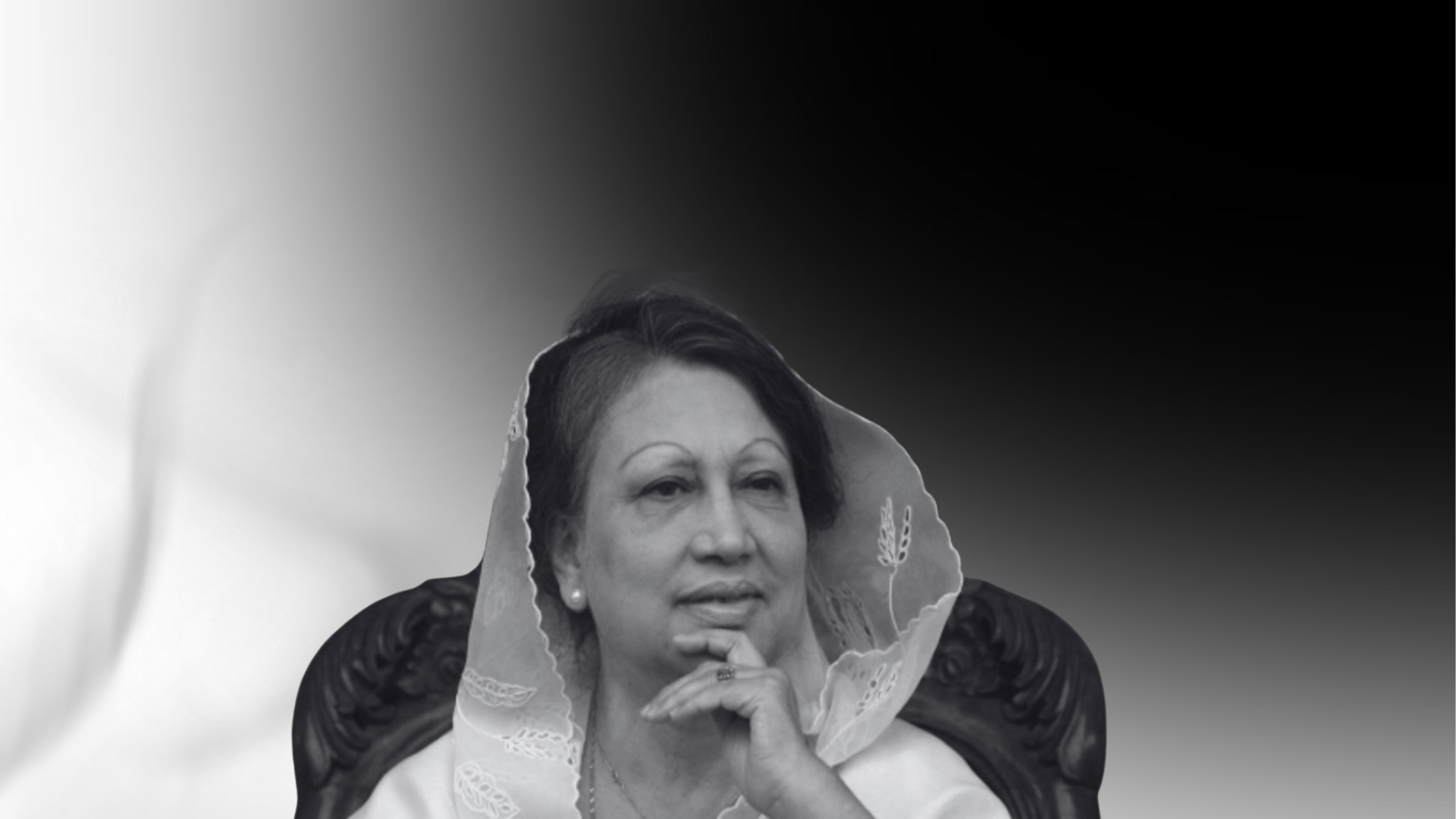
On 30 December 2025, former prime minister and BNP chairperson Khaleda Zia died while undergoing treatment at Dhaka’s Evercare Hospital. Soon after, Sheikh Hasina, leader of the Awami League- a now banned political party which has ruled Bangladesh alongside Khaleda since the 1990s, issued a condolence message, terming Khaleda’s death as an irreparable damage for Bangladesh’s politics. The message has surprised many, as Khaleda and Hasina are known as political archrivals having longstanding animosity towards one another. No matter how negatively they viewed each other, the scale tilted to one side, as the repression and torture that Sheikh Hasina had inflicted on Khaleda Zia during her tenure as prime minister from 2009 to 2024 exacerbated Khaleda’s ill health, due to which she finally died.
As Khaleda Zia’s BNP and Sheikh Hasina’s Awami League had ruled Bangladesh chronologically till the landslide victory of the latter in the 2008 election, this tendency taught Hasina a great lesson. She waited for the right moment, and after winning the 2014 and 2018 elections which was boycotted by and orchestrated against BNP, she got the leverage to eliminate Khaleda Zia from politics and paralyse BNP to such extent that they might never be able to rise to power again.
The repression on Khaleda by Hasina began in 2018, when the Hasina government brought controversial charges of corruption against Khaleda. Two of the most known cases of this time are known as the Zia Orphanage Trust case and Zia Charitable Trust case. Twice in 2018, Khaleda was convicted in these cases by a highly partisan judiciary and was sentenced to 17 years in prison. She was first put into Dhaka Central Jail in Old Dhaka, where she was the only prisoner in the entire complex.
The drama had just started. Considering her old age, the Awami League government suspended her jail sentence in 2020 and let her live at her house in Gulshan, with the conditions that she won’t take part in politics and won’t leave for treatment abroad. The confinement amounted to a house arrest, meaning that Khaleda couldn’t move outside her house. Under house arrest, Khaleda’s health deteriorated, and she was admitted first to Bangbandhu Sheikh Mujib Medical University (BSMMU) and later to Evercare Hospital.
Khaleda’s doctors had long been urging the Hasina government to send her abroad for treatment, fearing for her life. Back in 2018, Khaleda had developed Rheumatoid Arthritis, and became unable to use her left hand. In 2021, Khaleda suffered Liver Cirrhosis, and had internal bleeding twice in the span of a single week. From 2018 to 2023, Khaleda’s doctors were speaking of her ailing situation and requesting the government to send her abroad, but Hasina did not pay heed. Hasina said at the time that a convicted criminal can’t leave the country at any cost, which showed her apathy towards her political rival’s health condition and questions her willingness to keep her alive.
Since the July uprising that ousted Sheikh Hasina from power in August 2024, all the charges against Khaleda Zia were withdrawn by the interim government led by Nobel laureate Prof Muhammad Yunus. Khaleda has flown to London once and sought treatment there. But it was too late. The carelessness with which her health has been dealt since Hasina’s time had deteriorated her health to such an extent that she reached a point of no return. Finally, she breathed her last on Monday morning.
Since Khaleda’s death, people from all walks of life have been claiming her as an unbowed, uncompromising leader. Whether its Awami League, Jamaat, NCP or the leftist parties- everyone is mourning her death. This shows what a unifying political figure Khaleda had turned into during her lifetime. During the military-backed caretaker government period in 2007-2008, there had been a plan to rid the country of both Khaleda Zia and Sheikh Hasina- something known as the minus two formula. To make BNP leaderless, Khaleda’s son and a promising young leader, Tarique Rahman, was forced to go into exile in the United Kingdom and refrain from taking part in BNP’s active politics for 17 long years.
However, the past regimes could not separate Khaleda Zia from the touch of this land. Hearsay goes like this that although she was offered an abode abroad, Khaleda did not accept it and decided to stay in this country. This well-known fact only increased Khaleda’s stature, as this firm stance made her patriotism appealing to the country’s people.
From a quiet housewife to the first woman prime minister of Bangladesh- Khaleda has seen it all. From universal primary education to large-scale infrastructure and a strong foreign policy, Khaleda has been a formidable player in Bangladeshi politics. No matter how hard Sheikh Hasina tried to depict Khaleda as a looter of orphan’s money, the people refused to accept her as such. This clean political image has proven to be true, as upon her death, even her opponents expressed sympathy, something uncommon for any other Bangladeshi leader.
The success of Khaleda lies in the fact that she has been able to raise a capable progeny who might carry forward her legacy with honor. Her son, Tarique Rahman, is back in Bangladesh, and her granddaughter, Zaima Rahman, is also preparing to enter politics. Both of them have gained massive following and praise from the Bangladeshi people through their actions and words so far, and BNP looks jubilant enough to mark a fresh beginning through winning the upcoming election in February.
However, Khaleda could not see the political changes that Bangladesh might witness in the coming days with her own eyes. This is the only regret that everyone might have right now.
Muhammad A. Bashed is the joint editor of Muktipotro
