

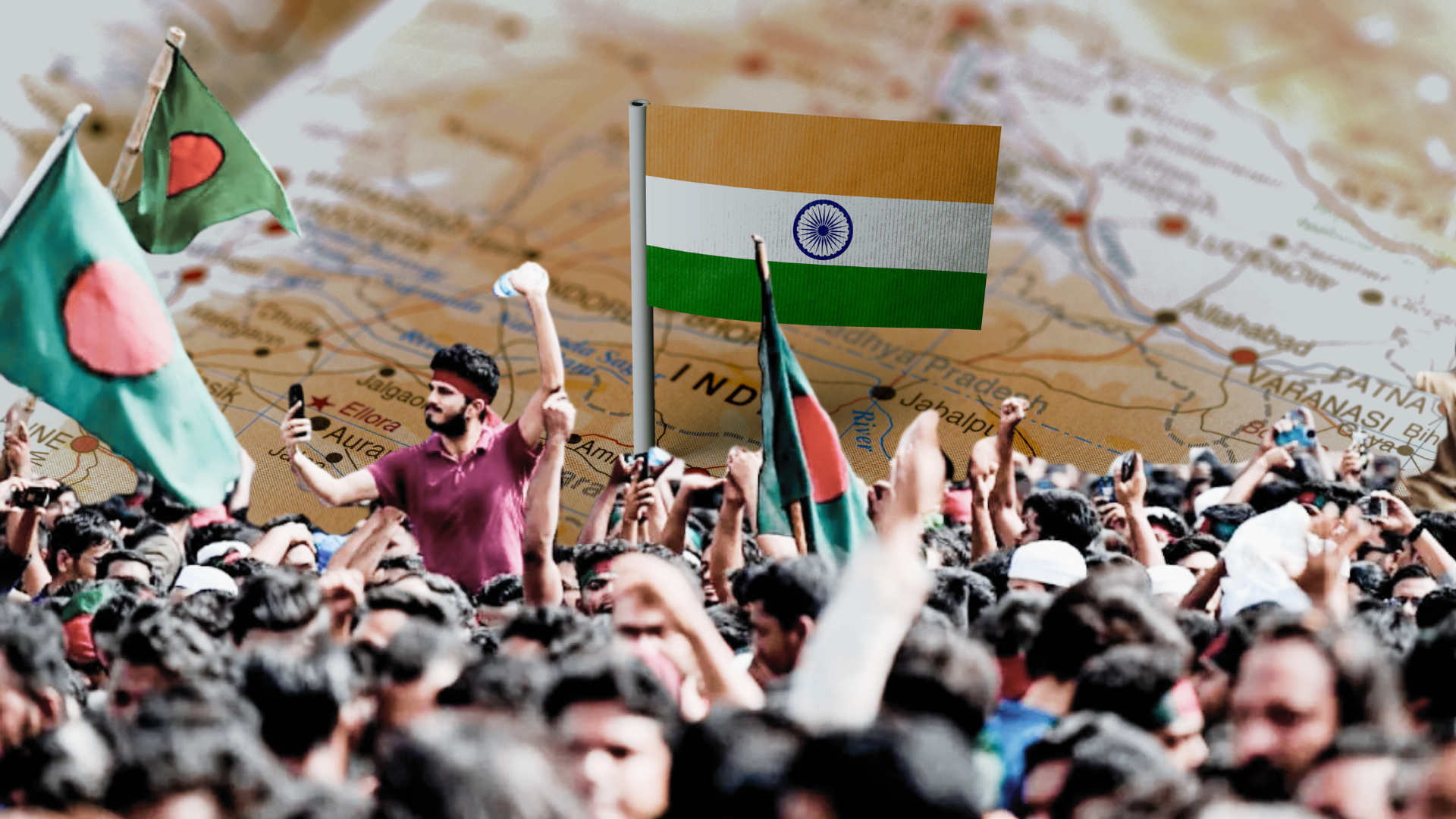
“The resistance against the Indian hegemony, which was present inside the spirit of the liberation war, was not allowed to grow……..The fissure inside the spirit of the liberation war was exploited by the politics of religious identitarianism. It transformed the anti-indian hegemony resistance into anti-Hindu communalism.” (Parvez Alam, Shahbag Er Rashtro Prokolpo,Translated by Sadman Ahmed Siam)
It has been almost unanimously agreed to recognise the late Abrar Fahad, a student from Bangladesh University of Engineering and Technology, as one of the martyrs against Indian expansionism, especially after 5th August 2024, the fall of the dictatorship of Sheikh Hasina. There was a widespread sentiment among the population of Bangladesh that under the Hasina regime, Bangladesh had become a sort of client state of India. There is a lot of evidence to suggest that this accusation was indeed true, and one of the hallmarks of that client status is what Fahad’s last Facebook post had been about – the distribution of the water of the Teesta River, which has been a source of misery for our citizens in North Bengal for a long time. After this status, he was murdered gruesomely by the activists of now-banned Bangladesh Chhatra League, the student wing of Bangladesh Awami League.
Fahad has been hailed as a hero of resistance against the Indian hegemony, and rightfully so. A memorial has been built in remembrance of his courage to speak out against the wrongdoings of the state. The nation has observed October 7, the day on which he was murdered, as a national day.
But what happened to the Teesta River issue?
There is a notable silence from the state on that front. The issues surrounding the distribution of the water of the Teesta are very popular, as evidenced by the fact that the long march of the Bangladesh Nationalist Party hosted hundreds of people. But the Interim Government is yet to take any proper action regarding the treaty. This feels very odd considering the amount of resources spent on remembering Abrar Fahad. But it can be argued that honouring his legacy should entail a visible action against the injustice of Indian policies. But as much as this Government has touted itself very much against the Indian hegemony, very few have actually resulted in reality.
Months ago, the Press Secretary, Shafiqul Alam, criticised the activists of the Fulbari Uprising against the open-pit coal mining project, saying that this resulted in dependence on India for the energy sector. He also claimed that the activists who were very vocal against the Fulbari coal-mining project were not seen when Sheikh Hasina initiated projects such as Rampal. Setting aside the fact that many activists were indeed active during both of these protests, there is a further question of what the Interim has done to rectify that energy dependency.
It hasn’t cancelled any of the projects with India, especially the Rampal Power Plant Project, which has numerous corruption allegations against it as well. The Adani deals are still hanging. Border killings haven’t stopped at all; periodically, reports come of how the BSF treats our citizens at the border – how they are murdered. Not being able to bring Sheikh Hasina, who was responsible for the despotic regime of the last 15 years, is also a diplomatic failure. The question of the distribution of water was mentioned earlier; it hasn’t seen much development either.
Granted, these are all multifaceted and complex issues, and it is unreasonable to expect that the Interim Government will be capable of solving them in such a short timespan. But can’t they be revealed to the citizens of Bangladesh? The lack of transparency during the deals was criticised by many, but the Interim Government seems to follow the last regime in this regard.
As a response to the foreign policy of Sheikh Hasina over the last 15 years, post-July 2024 Bangladesh has seen a surge in anti-Indian sentiment. Almost every politician seems very keen on emphasising that they are anti-India, or, more correctly, anti-Indian hegemony. Many connected to the Interim Government have also showcased their stance against the Indian hegemony from time to time. Even Chief Advisor Dr Muhammad Yunus had once remarked on the Seven Sisters at the beginning of his tenure and got praised by many.
But at the same time, this anti-Indian sentiment has hardly resulted in any concrete plans or proposals on how to counteract that hegemony. Notably, the Bangladesh Nationalist Party has taken initiatives to revive the Teesta issue to the forefront of their politics. But otherwise, this has been a silence on the policy front. This creates a very complex situation, which is hinted at in the beginning with the quote of Parvez Alam.
The grievances of the Bangladeshi citizens against India are very real and deserve attention. But without proper procedures to address those grievances, anti-India sentiment might very well become another scapegoat. The scapegoat can come in many shapes and forms – what Alam hints at the beginning is a form of communalism. Since 1947, communalism has had a great role to play in Southeast Asian politics, and very often, that communal violence starts over a pretence of labelling the minorities as loyal to another nation. In India, muslims are often accused by their right-wing as being agents of Pakistan, or being loyal to Pakistan. According to the right-wing, they cannot be trusted because their true allegiance lies elsewhere. Similarly, there is a tendency in Bangladeshi politics to imagine the Hindu population as being loyal to India and traitors to Bangladesh. And there remains a risk that the deserved and just frustration against Indian policies results in communal violence against the minorities.
Or, in the newer age, the scapegoat can be anyone who opposes the dominant viewpoint as well. Just like the word “Shahbagi”, being “Pro-Indian” is also now a smear hurled at different politicians, intellectuals or civil society members. Influencers who control the digital space of Bangladesh while living abroad consistently accuse everyone who disagrees with them as an Indian agent. This cheap populism of exploiting legitimate anti-India sentiment has the risk of hurting minorities or dissident voices in the end. The influencers, pundits, and politicians should be aware of not hurting their own citizens in the pursuit of justice.
The relationship between Bangladesh and India has gone through many ups and downs, and Bangladeshi citizens have suffered the consequences of India’s unjust foreign policy. The river issues are a supreme example, along with the support of the Indian state during the brutal dictatorship of Sheikh Hasina. While it is laudable that these issues are coming to the surface after July 2024, this has to be accompanied by concrete actions to address those sufferings. Otherwise, these legitimate concerns have the potential to become the pretext for suppressing minorities or dissidents in the future. The Interim Government, or the elected government which is supposed to form after the elections in February, must not fall into the cheap populism of anti-Indian sentiment and act accordingly.
Sadman Ahmed Siam is an independent columnist and a student at the Islamic University of Technology.
