

The darkness that comes down on the Chittagong Hill Tracts after midnight is not something you can reason with. It is not the thin, negotiable dark of a town — it does not have streetlamps at its edges or
the distant smear of a market’s fluorescence to orient you. It is a darkness that the hills make themselves, absolute and without exception, and it falls the same way on every night regardless of what is
about to happen in it.
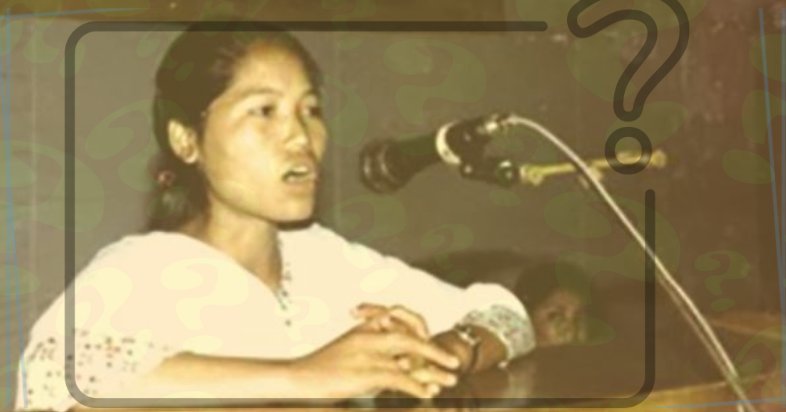
Kalpana Chakma had grown up in that darkness. Her village, New Lalyaghona in Baghaichari upazila, Rangamati, sat in a crease of the hills far from anything that might be called a town. She was twenty years old in the early months of 1996, and the people who knew her from those years describe someone who was constitutionally incapable of leaving a wrong unaddressed. She was the organising secretary of the Hill Women’s Federation — a body that documented what was being done to indigenous women in the Chittagong Hill Tracts and said so plainly in the language of protest — but she had also been known, long before she held any title, as a woman who would stand up in a meeting and challenge the men on the platform. Meghna Guhathakurta, an adviser to the International CHT Commission, would later write that Kalpana did not interpret democracy as merely free and fair elections. She saw it as something that had to include her — as a Chakma and as a woman — and she was impatient with those in her own movement who preferred the broader political struggle to remain silent on the question of women’s emancipation.
She organised conferences. She made speeches. She knocked on doors. She documented rapes and abductions and killings with the methodical, angry attention of someone who understood that the first act of power against the powerless is to ensure their suffering goes unrecorded. In the weeks before the seventh national parliamentary election, scheduled for 12 June 1996, she threw herself into campaigning for Bijoy Ketan Chakma, an independent candidate backed by Pahari Gana Parishad and supported by the broad coalition of hill peoples’ organisations. She went from village to village. She was good at it — at talking to people, at persuading them that their participation mattered, at making the abstract business of an election feel like something that belonged to them.
A few days before the vote, she did something that would prove fateful. She stood in front of Lieutenant Ferdous Kaisar Khan, the commander of the Kojoichari army camp near her village, and accused him by name. Fifteen days earlier, seven houses belonging to Chakma families had been burnt to ash, along with a Buddhist temple. She said the lieutenant had ordered it. She was also demanding an inquiry into the rape and murder of Shapna Rekha Chakma, a young girl from her own village —
someone she had known, in a place small enough that everyone knew everyone. She made the accusation publicly, in front of witnesses, with the matter- of-fact directness that those who remembered her said was simply how she was.
Ferdous Kaisar Khan did not forget it. At roughly half past one on the morning of 12 June — the polls would open in a matter of hours — armed men surrounded the family home in New Lalyaghona. They came without uniforms. They broke the door. Kalindi Kumar Chakma, Kalpana’s elder brother, was inside. So was their younger brother, Lal Bihari. The men took all three of them — bound them, pushed them out into the hill dark, marched them away from the house. In the confusion, moving through ground he knew, Kalindi heard the men say the word shoot. There was a wetland close by, a beel. He and Lal Bihari threw themselves into the water. They swam. They came out the other side. They ran. Kalpana did not reach the water. From somewhere behind him in the dark, Kalindi heard his sister’s voice.
One word. A sound aimed at the only person she could still reach. Dada.(Brothrer)… Then he heard nothing more from her, ever again. He walked to Baghaichari police station the following morning and filed a case under Section 364 of the Penal Code — abduction with intent of wrongful confinement and murder. He named three men: Lieutenant Ferdous Kaisar Khan of Kojoichari army camp; VDP member Nurul Huq; and police constable Saleh Ahmed of Ugolchari. He had recognised them in the dark. He gave their names.
The police registered the case. They omitted all three named individuals from the First Information Report. The accused were recorded as ten to twelve persons unknown. This was not a clerical error. It was a door being quietly closed at the very beginning of a process that would spend the next twenty-eight
years closing doors. Under pressure from rights groups and the national press, the Home Ministry assembled a three-member judicial inquiry commission in September 1996 — a retired Supreme Court judge, the Divisional Commissioner of Chittagong, and Professor Anupam Sen of Chittagong University’s sociology department. The commission interviewed ninety- four people. Lieutenant Ferdous himself sat before them. The commission’s report, forty pages long, was submitted in February 1997 and immediately classified. No one outside the government saw it for fifteen years, until an English-language daily obtained a copy in 2011 and published what it contained.
The conclusion: Kalpana Chakma had been abducted, willingly or unwillingly. The commission could not identify who had done it, for lack of witnesses and evidence. The commission had interviewed ninety-four people. Kalindi Kumar Chakma — who had been dragged from his own home that night, who
had recognised three of the men by face, who had heard his sister cry out before she was taken — was one of them.
Professor Sen admitted in 2010 that the commission had not possessed full investigative powers. It could ask questions. It could not compel answers. After the commission came the Criminal Investigation Department. The CID spent sixteen years on the case and produced a report that settled nothing. Then Rangamati police submitted their own final report in 2010 — inconclusive on the suspects. Kalindi filed a no-confidence petition and demanded reinvestigation. The court agreed. A new superintendent of police was assigned in 2016. His report, submitted two years later, noted that Kalpana had indeed been abducted — but that since she was herself the primary witness to her own abduction, no progress was
possible until she came back.
This sentence deserves to be read twice. The investigating officer told a court that the investigation could not advance because the victim had not returned to testify about her own disappearance. By 2016, thirty-nine police officers had worked on the case. According to Kalindi and his legal team, not one of them had formally interrogated the three named suspects. Ferdous Kaisar Khan — by then a retired serviceman — had appeared before the 1996 judicial commission. He does not appear to have been formally questioned by any of the police investigators who came after.
On 23 April 2024, the Senior Judicial Magistrate Court in Rangamati accepted the final police report and dismissed the case. Kalindi’s no- confidence petition was rejected. The named accused were absolved. Kalpana Chakma has been missing for twenty-nine years. Nobody has been charged. Nobody has stood trial. It is also worth recording what the state said during the years it was not investigating. In July 1996, six weeks after the abduction, the army issued a statement suggesting Kalpana had fled the country on her own passport. No passport record was produced. A separate account, circulated from within certain quarters of the military, proposed that Lieutenant Ferdous and Kalpana had eloped. No evidence was offered for this either. The army simultaneously announced a reward of fifty thousand taka for anyone who could provide information on her whereabouts — a peculiar gesture toward a woman they claimed had left of her own accord.
These stories had a purpose. In a country where institutional statements carry gravity regardless of their factual basis, even unsubstantiated rumours — elopement, self-exile, voluntary departure — lodge in the public mind and do their quiet work of muddying the account that an eyewitness had already given. Kalindi Kumar Chakma named three men on the morning of 12 June 1996. The counter-narrative ensured that those names would never be the only version of events in circulation.
What the rumours revealed, in spite of themselves, was a portrait of the woman they were trying to erase. The army’s suggestion that she had eloped with Ferdous was not merely false — it was a specific kind of lie, one that sought to reduce a young political activist to a romantic subplot, to make her disappearance a matter of private desire rather than public violence. It said something about what those who made it feared: not her as a victim, but her as an agent. A woman with a passport and a choice. A woman who had to be given a motive for leaving, because the alternative — that she had been silenced for what she was doing — was too legible.
The timing of her abduction has never been sufficiently reckoned with in the mainstream. She was taken in the hours before an election in which she was actively campaigning for an indigenous candidate, having days earlier confronted the local army commander by name over the burning of homes in her village. The CHT in 1996 was the most heavily militarised territory in Bangladesh. The peace accord with the Jana Sanghati Samiti was still a year away. The political stakes of indigenous participation in that election were not trivial, and Kalpana understood them — she was not a bystander to history, she was attempting to shape it, in the small and essential way that people shape it when they go from door to door and tell their neighbours that their vote is worth casting.
She was taken at the most exposed moment available: the night before the vote, in the dark, by men in plain clothes who knew where she lived. The state’s position, maintained across nearly three decades, is that it cannot establish who those men were. Kalindi Kumar Chakma is not a young man any more. He has carried the same testimony through police stations, magistrate courts, press conferences and human rights forums for the better part of thirty years. The account has not changed because the facts have not changed. The dark. The wetland. The word shoot. His sister’s voice from somewhere behind him, one word, his name in the form she used for him.
In June 2025, on the twenty-ninth anniversary of the abduction, he told a reporter: the police spent twenty-nine years not interrogating the accused. Then the court dismissed the case. He said he would keep fighting. There is no drama in how he says these things now. The outrage has been ground down by repetition into something flatter and harder — a refusal, simply, to let the matter be officially buried while he is still alive to contest it.
The CHT Peace Accord was signed in December 1997. It was supposed to mean something different for the hills. It has not meant enough. Michael Chakma, who had spent years publicly demanding justice for Kalpana, disappeared in April 2019 — from Dhaka, not the hills, as though the geography of impunity had widened. Human Rights Watch has described Kalpana as among the first victims of what became a pattern in Bangladesh. The pattern did not wait for her case to be resolved before repeating itself.
Most people in Bangladesh do not know her name. This also is not an accident.
She was born on 1 May 1976 in Baghaichari — the same hills, the same district, the same darkness she was taken into twenty years later. She was a feminist who criticised her own movement for subordinating
women’s emancipation to the broader political cause. She was impatient with male-dominated platforms and said so. She went to the homes of women who had been violated and wrote down what had happened to them. She stood in the road and told a lieutenant to his face what he had done. She knocked on doors for a candidate the powerful did not want elected. She was twenty years old and she had, as those who
remembered her consistently noted, an absolute inability to treat an injustice as someone else’s problem.
The court has now closed the case. The named accused are legally free. The thirty-nine officers who investigated across twenty-eight years never, it appears, formally questioned the men whose names Kalindi gave on the morning after his sister vanished.
And Kalindi — who was there, who swam out of that wetland, who heard what she said — keeps returning to the institutions that have failed him, with the same account, in the same words, because that is the only thing left that cannot be officially dismissed.
A word, in the dark, in the hills.
Dada…
He has been carrying it for thirty years. It is the one piece of evidence the state has never found a way to lose.
